
How Pat McDonagh Built Supermac’s Into a €314m Business
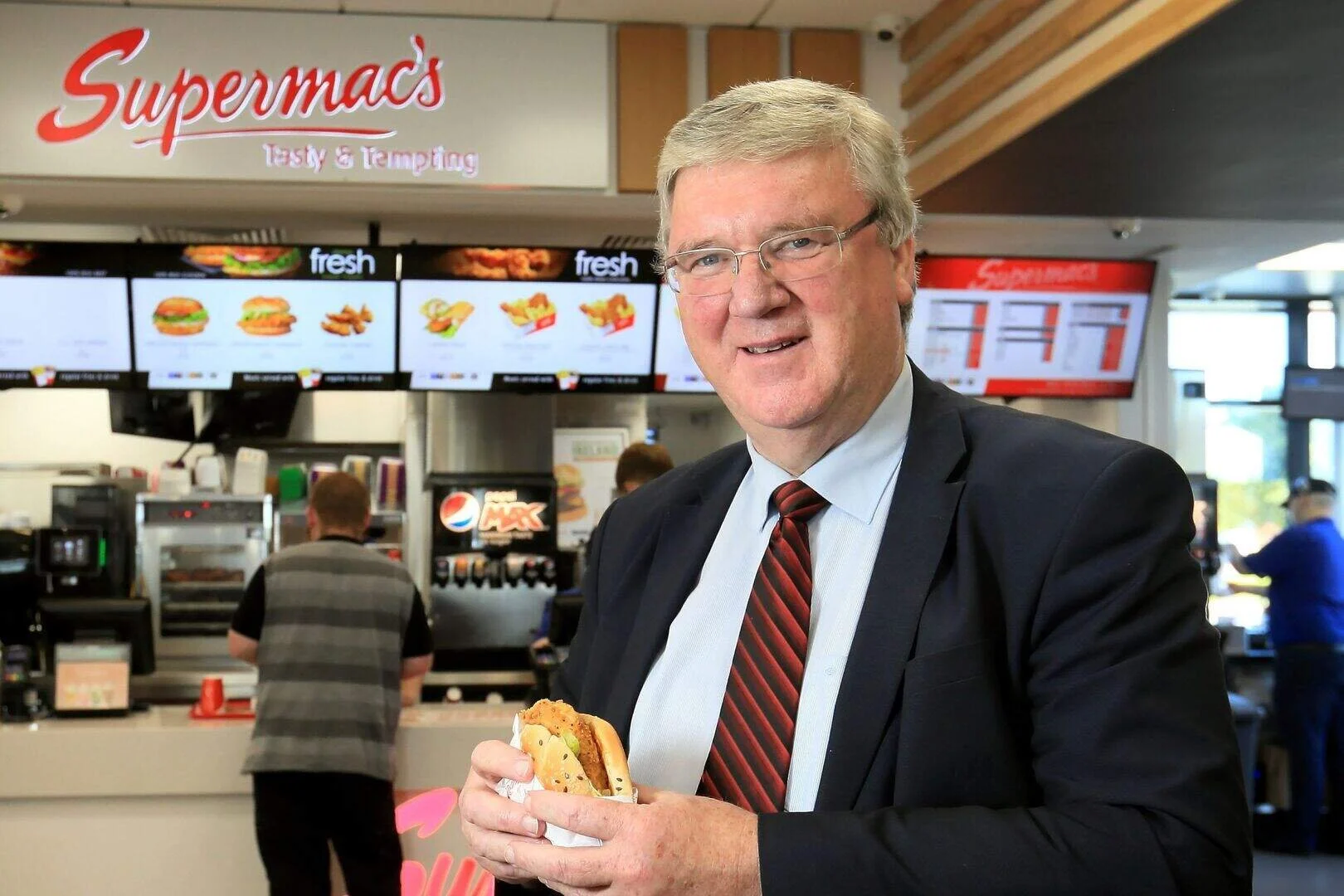
A former schoolteacher who opened a small fast-food outlet in Ballinasloe in 1978 has built one of Ireland's biggest home-grown hospitality businesses.
The latest publicly reported consolidated accounts for Supermac’s (Holdings) Ltd, covering the year to December 2024, show group revenue of €314.1 million — the first time it had passed €300 million — alongside €39.44 million in pre-tax profit and €32.95 million in profit after tax.
There is an important distinction, however. The €314.1 million figure is annual turnover, not a €314 million valuation of Supermac’s and not Pat McDonagh's personal wealth.
And the business represented by those accounts is considerably broader than burgers and snack boxes. The group has expanded into motorway service stations, hotels and property, while its restaurant operation incorporates franchised stores and other food brands.
Information checked and updated: September 2026
At a Glance
• 1978 — Pat McDonagh opened the first Supermac’s on Main Street in Ballinasloe, Co Galway.
• €314.1 million — Supermac’s group revenue in 2024, up approximately 7% from €294.37 million in 2023.
• €39.44 million — group pre-tax profit in 2024.
• €32.95 million — group profit after tax in 2024.
• €139.65 million — cash held by the group at the end of 2024, up from €111.65 million a year earlier.
• €285.99 million — accumulated profits reported at the end of December 2024.
• 2,458 employees — average employment reported for 2024, consisting of 2,279 operating staff and 179 management and administration staff.
• 50% each — Pat McDonagh and his wife Úna McDonagh each hold half of Supermac’s (Holdings) Ltd, according to reporting based on the company accounts.
• More than 120 restaurants — the scale of the Supermac’s network reported by Business Plus in November 2025.
How did Pat McDonagh start Supermac’s?
The Supermac’s story began well away from Ireland's traditional centres of big business.
McDonagh was a teacher in Kilrickle, Co Galway, when he identified an opportunity in the fast-food market. He had bought a small building on Main Street in Ballinasloe and originally considered turning it into a pool hall.
Planning permission for that idea was refused.
McDonagh subsequently recalled considering several alternative businesses before settling on fast food, partly because the other options required more capital. According to his own account, the first Supermac’s was opened on an extremely limited budget.
The restaurant opened in Ballinasloe in 1978.
A second location followed in Gort in 1980, before the business expanded into Galway city, with an Eyre Square premises opening in the early 1980s.
The name itself came from McDonagh's school nickname, “Supermac”.
What had begun as one small takeaway was gradually turned into a recognisable Irish fast-food brand.
How Supermac’s grew from one shop into a national chain
Supermac’s did not reach €300 million in revenue simply by opening hundreds of identical company-owned takeaways.
Its development can instead be understood as several stages of expansion.
1. Building a fast-food brand for the Irish market
One of Supermac’s most important early advantages was that it was built around Irish consumer tastes rather than importing an overseas restaurant format unchanged.
Its menu developed around products such as burgers, chips, chicken and the Snack Box while offering a wider range than many traditional burger chains.
The company's own history points to its menu, product quality, local sourcing and strong operational involvement as central parts of its growth.
That local positioning helped Supermac’s build significant brand recognition, particularly outside Dublin.
2. Using franchising to expand faster
Franchising became another important element.
Instead of Supermac’s having to own and operate every restaurant itself, independent franchisees could run outlets under the Supermac’s brand and operating system.
Supermac’s says franchisees receive assistance with areas including:
• Site selection
• Store design
• Training
• Operational support
• Central purchasing and distribution
• Marketing
• Human resources
• IT systems
• Food safety and health and safety management
The model allows the brand to expand while sharing some of the investment and operating responsibilities with individual business owners.
An Irish Times profile from 2011 showed how significant franchising had already become: at that stage, 68 of 102 Supermac’s outlets were reported to be operated by franchisees.
The exact mix has changed since then, but franchising remains part of the company's model.
3. Adding Papa John’s to existing restaurants
Supermac’s then found another way to generate sales from the same locations.
In 2004, McDonagh entered into a partnership with Papa John’s, giving Supermac’s the master franchise for the pizza brand on the island of Ireland.
Supermac’s says more than 85 Papa John’s outlets have subsequently been opened within existing Supermac’s stores.
This “brand within a brand” model matters financially.
Rather than relying on one menu to generate revenue from a restaurant property, the same premises can sell Supermac’s products alongside Papa John’s pizzas and, in some locations, SuperSubs and other offerings.
That potentially allows a site to appeal to a wider range of customers without requiring a completely separate building for every brand.
The motorway-plaza strategy changed the scale of the business
One of the clearest shifts in the McDonagh business model has been the move beyond traditional high-street restaurants into large roadside service stations.
McDonagh himself has identified the motor-services business as an important contributor to growth.
The Plaza Group, formed by Pat and Úna McDonagh, operates motorway and major-route service stations combining a number of revenue-generating activities in a single location.
Depending on the plaza, these can include:
• Supermac’s
• Papa John’s
• SuperSubs
• Mac’s Place deli or bakery
• Coffee
• Convenience retail
• Petrol and diesel
• EV charging
• Other restaurant brands
The Plaza Group portfolio includes sites such as Barack Obama Plaza, Galway Plaza, Portlaoise Plaza, N17 Tuam Plaza and Mallow N20 Plaza.
This is a fundamentally different business proposition from a takeaway on a town's main street.
A motorway plaza can make money from the same customer visit through food, coffee, retail purchases and fuel.
It also gives the group control of strategically located property beside some of Ireland's busiest roads.
The €20 million Banner Plaza
The scale of that strategy can be seen in one of its latest developments.
The Banner Plaza, beside Junction 12 of the M18 near Ennis, was officially opened in April 2026 following an investment reported at €20 million.
The development created approximately 120 jobs.
The site includes food, convenience retail, fuel and EV charging, demonstrating how far the business model has evolved from the original Ballinasloe takeaway.
Hotels added another major source of revenue
McDonagh has also diversified into hotels through the Só Hotel Group.
As of September 2026, the group lists six hotels:
• Charleville Park Hotel, Co Cork
• Lough Rea Hotel & Spa, Co Galway
• The Killeshin Hotel, Portlaoise
• Castletroy Park Hotel, Limerick
• Castle Oaks House Hotel, Castleconnell
• Athlone Springs Hotel & Leisure Club
Hotels provide a completely different revenue stream from fast food, including accommodation, weddings, conferences, food and beverage sales and leisure facilities.
They also diversify the group.
A decline in one sector does not necessarily affect restaurants, hotels, retail and property in exactly the same way.
The Covid-19 pandemic demonstrated the limitations of that diversification, however, because hospitality restrictions affected several parts of the business simultaneously.
How much money does Supermac’s actually make?
The latest accounts give the clearest picture.
Supermac’s group financial performance
2019
• Revenue: €189.4 million
• Pre-tax profit: €24.5 million
2021
• Revenue: €195.7 million
• Pre-tax profit: approximately €29.5 million
• Post-tax profit: approximately €24.1 million
The 2021 figures were affected by pandemic trading conditions and State Covid supports.
2022
• Revenue: €276.29 million
This figure is reported as the comparative revenue figure in the group's 2023 accounts.
2023
• Revenue: €294.37 million
• Pre-tax profit: €43.6 million
• Post-tax profit: €36.07 million
• Cash: €111.65 million
2024
• Revenue: €314.1 million
• Pre-tax profit: €39.44 million
• Post-tax profit: €32.95 million
• Cash: €139.65 million
• Accumulated profits: €285.99 million
Digital Dinny calculation: how fast has revenue grown?
Supermac’s group revenue increased from €276.29 million in 2022 to €314.1 million in 2024.
That represents an increase of:
€314.1m − €276.29m = €37.81 million
or approximately:
13.7% growth over two years.
That works out at an annualised compound growth rate of roughly 6.6% per year.
Revenue increased by approximately:
• €18.08 million between 2022 and 2023
• €19.73 million between 2023 and 2024
Based on the 2024 accounts, the group was therefore generating an average of roughly:
€6.04 million in revenue every week.
This is an illustrative calculation based on reported annual revenue and does not mean sales were evenly distributed across every week.
Profit is not the same thing as turnover
This distinction is particularly important when reporting on large businesses.
Supermac’s generated €314.1 million in turnover during 2024, but that does not mean its owners made €314.1 million.
Turnover is the money generated from sales before the company's expenses are deducted.
Once costs such as food, wages, energy, property costs, administration, depreciation and other expenses are accounted for, the group's pre-tax profit was €39.44 million.
That equates to a pre-tax profit margin of approximately:
€39.44m ÷ €314.1m = 12.6%.
After tax, profit was €32.95 million, equivalent to about 10.5% of turnover.
In simple terms, for every €100 of group revenue recorded in 2024, roughly €12.60 remained as profit before tax.
Why did profit fall despite record sales?
Revenue reached another record in 2024, but pre-tax profit fell 9.5%, from €43.6 million to €39.44 million.
One significant factor was a sharp rise in pension costs.
The group's total staff costs increased from €57.1 million to €68.89 million, including:
• €56.19 million in salaries
• €7 million in pension costs
• €5.69 million in social welfare costs
The accounts included €2 million in pension contributions for directors Pat and Úna McDonagh.
That means the fall in reported profit cannot simply be interpreted as evidence that trading deteriorated.
Sales actually increased.
Instead, higher costs absorbed a greater share of revenue.
How strong is Supermac’s financially?
Perhaps one of the most striking figures in the accounts is not turnover at all.
It is cash.
The group's cash balance increased from:
€111.65 million in 2023
to
€139.65 million in 2024.
That means cash alone was equivalent to around 44% of one year's 2024 turnover.
The group also reported €285.99 million in accumulated profits at the end of 2024.
Accumulated profits are retained earnings built up within the company over time. They should not be interpreted as €285.99 million sitting in a bank account or as money personally owned by Pat McDonagh.
But together with the group's cash position, they illustrate the financial resources generated through decades of profitable trading.
Revenue per employee: another way to understand the scale
Supermac’s reported an average of 2,458 employees during 2024.
Dividing annual group turnover by that employee figure gives:
€314.1 million ÷ 2,458 = approximately €127,800 revenue per employee.
This is not an estimate of what each worker generates individually or what an employee is worth.
It is simply a useful way of visualising the scale of the overall operation relative to its reported workforce.
Because the consolidated group contains different types of businesses, including restaurants and hotels, it should not be used as a direct productivity comparison with companies in unrelated sectors.
How much does Pat McDonagh personally make?
This is where company accounts need to be read carefully.
Pat McDonagh's personal income and personal wealth are not the same as Supermac’s group revenue, profit or cash.
Pat and Úna McDonagh each hold a 50% interest in the business, according to the company's accounts as reported by RTÉ.
The 2024 accounts reported combined directors' remuneration of €152,425, alongside the €2 million pension contribution relating to the two directors.
The accounts do not provide a basis for simply describing half of those amounts as Pat McDonagh's salary.
There were also other transactions involving McDonagh.
During 2024, the group reportedly:
• Paid €918,043 to Pat McDonagh in respect of property leased to the group.
• Repaid approximately €2.08 million of money previously owed to him.
• Still owed approximately €2.1 million to him at the end of the year.
These figures should not be added together and described as salary or profit.
Rent, pension contributions, director remuneration and repayment of a loan are all economically and legally different things.
Is Pat McDonagh worth €300 million?
There is no reliable basis in the latest Supermac’s accounts for saying Pat McDonagh personally has a net worth of €300 million.
The €314.1 million figure is group turnover.
Likewise, accumulated profits of €285.99 million belong within the group balance sheet and are not the equivalent of an owner's personal bank balance.
Calculating McDonagh's net worth would require valuations of his interests in private companies, personally owned property, investments, debts and other assets that are not fully disclosed publicly.
Published rich lists may produce estimates, but those should always be described as estimates rather than audited personal wealth.
The property strategy behind the restaurants
Another underappreciated part of the Supermac’s story is property.
The group has repeatedly invested in land, restaurants, hotels and service-station locations.
During 2024, it spent approximately €8.6 million acquiring property, plant and equipment, following spending of €8.44 million under the same heading during 2023.
In 2023, the group spent a wider €11.1 million on property, plant, equipment and investment property.
Owning or controlling strategic sites can create several benefits.
The business can make money from the operating activity on the site while also controlling an underlying property asset.
That is particularly significant when a location sits beside a motorway junction or another high-volume transport route.
The McDonald’s trademark battle
One of the most unusual chapters in Supermac’s development has been its long-running trademark dispute with McDonald’s.
The dispute arose partly from Supermac’s attempts to secure broader trademark protection and potentially expand beyond Ireland.
In 2017, Supermac’s applied to revoke elements of McDonald’s EU “Big Mac” trademark on the basis that it had not been put to genuine use for all of the goods and services for which it was registered.
In June 2024, the EU General Court ruled that McDonald's had failed to demonstrate genuine use of the Big Mac trademark over a continuous five-year period for certain poultry products and restaurant-related services.
The ruling was a significant victory for Supermac’s, although the broader trademark battle has continued.
In June 2026, Supermac’s suffered a setback in a separate EU trademark application.
Then, on 31 July 2026, the UK Intellectual Property Office ruled on a challenge involving the Supermac’s name and figurative mark, clearing an important obstacle to registration in Britain.
For a company whose physical business remains overwhelmingly Irish, securing trademark rights outside Ireland could be important if international expansion eventually becomes a major strategic priority.
What actually explains Supermac’s success?
There is no single reason.
Several decisions appear to have compounded over almost five decades.
1. It started in an underserved market
Rather than beginning in Dublin, Supermac’s established itself in towns in the west of Ireland where there was space for a locally tailored fast-food business.
2. The business expanded gradually
The first store opened in 1978.
The second followed in 1980.
This was not a company that attempted to build a national network overnight.
3. Franchising reduced the burden of expansion
Independent operators allowed Supermac’s to grow its geographical footprint while sharing investment and operating responsibility.
4. Multiple brands can operate from one property
Papa John’s, SuperSubs and other food offerings allow larger locations to serve different customer demands from the same site.
5. It followed customers from town centres onto the road network
Drive-through restaurants, forecourt partnerships and motorway plazas changed the potential economics of individual locations.
6. The group diversified into hotels and property
That created assets and revenue streams beyond fast food.
7. Profits were repeatedly reinvested
The continued investment in property and new locations is reflected both in historic interviews with McDonagh and in the group's annual capital expenditure.
8. The owners retained control
Unlike many growing restaurant businesses that bring in institutional investors, Supermac’s remains a privately controlled family company.
Pat and Úna McDonagh each retain a 50% ownership interest.
Worked example: what does €314.1 million in sales actually mean?
Imagine €100 being spent across the Supermac’s group during 2024.
Using the consolidated figures as a simplified illustration:
Revenue: €100
Pre-tax profit: approximately €12.56
Tax and other difference between pre-tax and post-tax profit: approximately €2.07
Post-tax profit: approximately €10.49
The remaining approximately €87.44 before tax profit is absorbed by the various operating and business costs reflected in the accounts.
This does not mean every Supermac’s burger has a 12.6% profit margin.
The accounts cover a diversified group, and individual restaurants, hotels and other operations will have different margins.
Advantages of the Supermac’s business model
Strong Irish brand recognition
Almost five decades of trading have created significant familiarity with the Supermac’s name.
Multiple revenue streams
Restaurants, franchises, motorway plazas, hotels, retail activity and property reduce reliance on one specific source of income.
Strategic property
High-quality roadside and retail sites can provide long-term competitive advantages that are difficult for a new entrant to replicate.
Strong liquidity
Cash of €139.65 million at the end of 2024 gives the group considerable financial flexibility.
Private ownership
The McDonaghs can make long-term investment decisions without the quarterly reporting pressures faced by a publicly listed company.
Risks and limitations
Success at this scale also creates major risks.
Labour costs
Restaurants and hotels are labour-intensive businesses.
The group's staff bill rose substantially during 2024, and Ireland's higher minimum wage, employment costs and pension requirements have continued to increase operating costs.
McDonagh warned in late 2025 that increases in wages, auto-enrolment, food prices and other overheads would make the operating environment more challenging.
Food and energy inflation
Even a small percentage increase in input costs can have a large effect across hundreds of millions of euro in annual sales.
Planning delays
Large plazas and drive-through developments require suitable land and planning permission.
The Banner Plaza, for example, took around a decade to reach completion.
Competition
Supermac’s competes not only with McDonald’s and Burger King but with coffee chains, convenience retailers, forecourt operators, delivery platforms and independent restaurants.
The directors themselves describe the group's market as highly competitive with continual pressure on costs and margins.
Diversification adds complexity
Operating hotels, restaurants, filling stations, convenience retail and property requires very different expertise.
Diversification can reduce some risks while increasing operational complexity.
What can Irish entrepreneurs learn from Supermac’s?
The most interesting lesson may be that Supermac’s did not become a €314 million-revenue group because of one breakthrough product.
Its growth came through repeated expansion of the original business model.
One restaurant became several restaurants.
Company-owned stores were supplemented by franchises.
Restaurants added pizza and other brands.
Traditional locations expanded into drive-throughs.
Drive-throughs evolved into major service stations.
The group then moved into hotels and property.
Each new layer used some combination of the brand, management experience, property knowledge, purchasing scale or cash generated by the businesses that came before it.
That compounding process took almost half a century.
Frequently Asked Questions
Who owns Supermac’s?
Supermac’s is privately owned. Pat McDonagh and his wife Úna McDonagh each hold a 50% interest in Supermac’s (Holdings) Ltd, according to the latest reported accounts.
How much revenue does Supermac’s make?
Supermac’s (Holdings) Ltd recorded €314.1 million in consolidated revenue for 2024, the latest full-year accounts publicly reported as of September 2026.
How much profit does Supermac’s make?
The group reported €39.44 million in pre-tax profit and €32.95 million in post-tax profit for 2024.
Is Supermac’s worth €314 million?
Not necessarily. €314.1 million was annual revenue, not a company valuation. A valuation would require a separate assessment of earnings, assets, debts, growth prospects and comparable businesses.
Is Pat McDonagh a billionaire?
There is no publicly verified evidence establishing Pat McDonagh as a billionaire. Private wealth estimates should not be confused with Supermac’s turnover or accumulated profits.
How many Supermac’s are there in Ireland?
Business Plus reported in November 2025 that the brand had more than 120 restaurants. Because outlets can open or close, the company's current restaurant locator should be checked for the latest number.
Does Supermac’s own Papa John’s?
No. Papa John’s is an international pizza company. Supermac’s holds the master franchise for Papa John’s on the island of Ireland and says it has opened more than 85 Papa John’s outlets within Supermac’s locations.
Does Pat McDonagh own hotels?
Yes. The Só Hotel Group describes itself as owned by Pat McDonagh and currently lists six Irish hotels.
Conclusion
Pat McDonagh's biggest business achievement is not simply building an Irish alternative to international fast-food chains.
It is turning a single Ballinasloe restaurant opened in 1978 into a diversified hospitality and property group capable of generating €314.1 million in annual revenue and almost €40 million in pre-tax profit.
Supermac’s restaurants remain at the heart of the brand, but motorway plazas, franchises, Papa John’s, hotels, property and decades of reinvestment increasingly explain the size of the overall business.
The €300 million figure should therefore be understood correctly: it represents annual group sales, rather than the value of Pat McDonagh's personal fortune.
And that distinction arguably makes the underlying business story more interesting — because it shows exactly how much commercial activity now sits behind one of Ireland's best-known home-grown brands.
Methodology and Financial Information Note
This article uses the latest publicly reported consolidated accounts for Supermac’s (Holdings) Ltd available at the time of review, alongside company information, court records and reputable Irish business reporting.
Calculations including revenue growth, profit margins, weekly turnover and revenue per employee were carried out by Digital Dinny using published figures and have been rounded.
Company turnover, profit, accumulated profits, cash and personal wealth are separate financial concepts and should not be treated as interchangeable.
Financial information in this article is for general informational purposes and is not investment, tax or financial advice.
Sources and Further Information
Supermac’s – company history
Background on the first restaurant, Pat McDonagh and the development of the business.
Supermac’s company history
RTÉ – Supermac’s 2024 accounts
Reporting based on consolidated Supermac’s (Holdings) Ltd accounts covering revenue, profits, staff costs, cash, ownership and accumulated profits.
Supermac’s group revenues top €300m for first time
RTÉ – Supermac’s 2023 accounts
Financial figures including €294.37 million revenue, €43.6 million pre-tax profit and €111.65 million cash.
Supermac’s 2023 financial results
Business Plus – history of Supermac’s growth
Background on the Ballinasloe opening, subsequent expansion and motorway-services strategy.
How Supermac’s grew to more than €300m turnover
The Plaza Group
Official information on the McDonaghs' motorway and primary-route service-station operations.
The Plaza Group business and locations
Só Hotels
Current hotel portfolio and group information.
Só Hotels portfolio
Papa John’s Ireland
Details of Supermac’s master-franchise relationship and Papa John’s outlets.
Papa John’s Ireland and Supermac’s partnership
Court of Justice of the European Union
Official information on the June 2024 Big Mac trademark judgment involving Supermac’s and McDonald’s.
EU General Court – Supermac’s v EUIPO and McDonald’s
UK Intellectual Property Office
Official July 2026 decision involving registration of the Supermac’s trademarks.
UKIPO Supermac’s trademark decision O/0686/26
A former schoolteacher who opened a small fast-food outlet in Ballinasloe in 1978 has built one of Ireland's biggest home-grown hospitality businesses.
The latest publicly reported consolidated accounts for Supermac’s (Holdings) Ltd, covering the year to December 2024, show group revenue of €314.1 million the first time it had passed €300 million alongside €39.44 million in pre-tax profit and €32.95 million in profit after tax.
There is an important distinction, however. The €314.1 million figure is annual turnover, not a €314 million valuation of Supermac’s and not Pat McDonagh's personal wealth.
And the business represented by those accounts is considerably broader than burgers and snack boxes. The group has expanded into motorway service stations, hotels and property, while its restaurant operation incorporates franchised stores and other food brands.
Information checked and updated: September 2026
At a Glance
• 1978 — Pat McDonagh opened the first Supermac’s on Main Street in Ballinasloe, Co Galway.
• €314.1 million — Supermac’s group revenue in 2024, up approximately 7% from €294.37 million in 2023.
• €39.44 million — group pre-tax profit in 2024.
• €32.95 million — group profit after tax in 2024.
• €139.65 million — cash held by the group at the end of 2024, up from €111.65 million a year earlier.
• €285.99 million — accumulated profits reported at the end of December 2024.
• 2,458 employees — average employment reported for 2024, consisting of 2,279 operating staff and 179 management and administration staff.
• 50% each — Pat McDonagh and his wife Úna McDonagh each hold half of Supermac’s (Holdings) Ltd, according to reporting based on the company accounts.
• More than 120 restaurants — the scale of the Supermac’s network reported by Business Plus in November 2025.
How did Pat McDonagh start Supermac’s?
The Supermac’s story began well away from Ireland's traditional centres of big business.
McDonagh was a teacher in Kilrickle, Co Galway, when he identified an opportunity in the fast-food market. He had bought a small building on Main Street in Ballinasloe and originally considered turning it into a pool hall.
Planning permission for that idea was refused.
McDonagh subsequently recalled considering several alternative businesses before settling on fast food, partly because the other options required more capital. According to his own account, the first Supermac’s was opened on an extremely limited budget.
The restaurant opened in Ballinasloe in 1978.
A second location followed in Gort in 1980, before the business expanded into Galway city, with an Eyre Square premises opening in the early 1980s.
The name itself came from McDonagh's school nickname, “Supermac”.
What had begun as one small takeaway was gradually turned into a recognisable Irish fast-food brand.
How Supermac’s grew from one shop into a national chain
Supermac’s did not reach €300 million in revenue simply by opening hundreds of identical company-owned takeaways.
Its development can instead be understood as several stages of expansion.
1. Building a fast-food brand for the Irish market
One of Supermac’s most important early advantages was that it was built around Irish consumer tastes rather than importing an overseas restaurant format unchanged.
Its menu developed around products such as burgers, chips, chicken and the Snack Box while offering a wider range than many traditional burger chains.
The company's own history points to its menu, product quality, local sourcing and strong operational involvement as central parts of its growth.
That local positioning helped Supermac’s build significant brand recognition, particularly outside Dublin.
2. Using franchising to expand faster
Franchising became another important element.
Instead of Supermac’s having to own and operate every restaurant itself, independent franchisees could run outlets under the Supermac’s brand and operating system.
Supermac’s says franchisees receive assistance with areas including:
• Site selection
• Store design
• Training
• Operational support
• Central purchasing and distribution
• Marketing
• Human resources
• IT systems
• Food safety and health and safety management
The model allows the brand to expand while sharing some of the investment and operating responsibilities with individual business owners.
An Irish Times profile from 2011 showed how significant franchising had already become: at that stage, 68 of 102 Supermac’s outlets were reported to be operated by franchisees.
The exact mix has changed since then, but franchising remains part of the company's model.
3. Adding Papa John’s to existing restaurants
Supermac’s then found another way to generate sales from the same locations.
In 2004, McDonagh entered into a partnership with Papa John’s, giving Supermac’s the master franchise for the pizza brand on the island of Ireland.
Supermac’s says more than 85 Papa John’s outlets have subsequently been opened within existing Supermac’s stores.
This “brand within a brand” model matters financially.
Rather than relying on one menu to generate revenue from a restaurant property, the same premises can sell Supermac’s products alongside Papa John’s pizzas and, in some locations, SuperSubs and other offerings.
That potentially allows a site to appeal to a wider range of customers without requiring a completely separate building for every brand.
The motorway-plaza strategy changed the scale of the business
One of the clearest shifts in the McDonagh business model has been the move beyond traditional high-street restaurants into large roadside service stations.
McDonagh himself has identified the motor-services business as an important contributor to growth.
The Plaza Group, formed by Pat and Úna McDonagh, operates motorway and major-route service stations combining a number of revenue-generating activities in a single location.
Depending on the plaza, these can include:
• Supermac’s
• Papa John’s
• SuperSubs
• Mac’s Place deli or bakery
• Coffee
• Convenience retail
• Petrol and diesel
• EV charging
• Other restaurant brands
The Plaza Group portfolio includes sites such as Barack Obama Plaza, Galway Plaza, Portlaoise Plaza, N17 Tuam Plaza and Mallow N20 Plaza.
This is a fundamentally different business proposition from a takeaway on a town's main street.
A motorway plaza can make money from the same customer visit through food, coffee, retail purchases and fuel.
It also gives the group control of strategically located property beside some of Ireland's busiest roads.
The €20 million Banner Plaza
The scale of that strategy can be seen in one of its latest developments.
The Banner Plaza, beside Junction 12 of the M18 near Ennis, was officially opened in April 2026 following an investment reported at €20 million.
The development created approximately 120 jobs.
The site includes food, convenience retail, fuel and EV charging, demonstrating how far the business model has evolved from the original Ballinasloe takeaway.
Hotels added another major source of revenue
McDonagh has also diversified into hotels through the Só Hotel Group.
As of September 2026, the group lists six hotels:
• Charleville Park Hotel, Co Cork
• Lough Rea Hotel & Spa, Co Galway
• The Killeshin Hotel, Portlaoise
• Castletroy Park Hotel, Limerick
• Castle Oaks House Hotel, Castleconnell
• Athlone Springs Hotel & Leisure Club
Hotels provide a completely different revenue stream from fast food, including accommodation, weddings, conferences, food and beverage sales and leisure facilities.
They also diversify the group.
A decline in one sector does not necessarily affect restaurants, hotels, retail and property in exactly the same way.
The Covid-19 pandemic demonstrated the limitations of that diversification, however, because hospitality restrictions affected several parts of the business simultaneously.
How much money does Supermac’s actually make?
The latest accounts give the clearest picture.
Supermac’s group financial performance
2019
• Revenue: €189.4 million
• Pre-tax profit: €24.5 million
2021
• Revenue: €195.7 million
• Pre-tax profit: approximately €29.5 million
• Post-tax profit: approximately €24.1 million
The 2021 figures were affected by pandemic trading conditions and State Covid supports.
2022
• Revenue: €276.29 million
This figure is reported as the comparative revenue figure in the group's 2023 accounts.
2023
• Revenue: €294.37 million
• Pre-tax profit: €43.6 million
• Post-tax profit: €36.07 million
• Cash: €111.65 million
2024
• Revenue: €314.1 million
• Pre-tax profit: €39.44 million
• Post-tax profit: €32.95 million
• Cash: €139.65 million
• Accumulated profits: €285.99 million
Digital Dinny calculation: how fast has revenue grown?
Supermac’s group revenue increased from €276.29 million in 2022 to €314.1 million in 2024.
That represents an increase of:
€314.1m − €276.29m = €37.81 million
or approximately:
13.7% growth over two years.
That works out at an annualised compound growth rate of roughly 6.6% per year.
Revenue increased by approximately:
• €18.08 million between 2022 and 2023
• €19.73 million between 2023 and 2024
Based on the 2024 accounts, the group was therefore generating an average of roughly:
€6.04 million in revenue every week.
This is an illustrative calculation based on reported annual revenue and does not mean sales were evenly distributed across every week.
Profit is not the same thing as turnover
This distinction is particularly important when reporting on large businesses.
Supermac’s generated €314.1 million in turnover during 2024, but that does not mean its owners made €314.1 million.
Turnover is the money generated from sales before the company's expenses are deducted.
Once costs such as food, wages, energy, property costs, administration, depreciation and other expenses are accounted for, the group's pre-tax profit was €39.44 million.
That equates to a pre-tax profit margin of approximately:
€39.44m ÷ €314.1m = 12.6%.
After tax, profit was €32.95 million, equivalent to about 10.5% of turnover.
In simple terms, for every €100 of group revenue recorded in 2024, roughly €12.60 remained as profit before tax.
Why did profit fall despite record sales?
Revenue reached another record in 2024, but pre-tax profit fell 9.5%, from €43.6 million to €39.44 million.
One significant factor was a sharp rise in pension costs.
The group's total staff costs increased from €57.1 million to €68.89 million, including:
• €56.19 million in salaries
• €7 million in pension costs
• €5.69 million in social welfare costs
The accounts included €2 million in pension contributions for directors Pat and Úna McDonagh.
That means the fall in reported profit cannot simply be interpreted as evidence that trading deteriorated.
Sales actually increased.
Instead, higher costs absorbed a greater share of revenue.
How strong is Supermac’s financially?
Perhaps one of the most striking figures in the accounts is not turnover at all.
It is cash.
The group's cash balance increased from:
€111.65 million in 2023
to
€139.65 million in 2024.
That means cash alone was equivalent to around 44% of one year's 2024 turnover.
The group also reported €285.99 million in accumulated profits at the end of 2024.
Accumulated profits are retained earnings built up within the company over time. They should not be interpreted as €285.99 million sitting in a bank account or as money personally owned by Pat McDonagh.
But together with the group's cash position, they illustrate the financial resources generated through decades of profitable trading.
Revenue per employee: another way to understand the scale
Supermac’s reported an average of 2,458 employees during 2024.
Dividing annual group turnover by that employee figure gives:
€314.1 million ÷ 2,458 = approximately €127,800 revenue per employee.
This is not an estimate of what each worker generates individually or what an employee is worth.
It is simply a useful way of visualising the scale of the overall operation relative to its reported workforce.
Because the consolidated group contains different types of businesses, including restaurants and hotels, it should not be used as a direct productivity comparison with companies in unrelated sectors.
How much does Pat McDonagh personally make?
This is where company accounts need to be read carefully.
Pat McDonagh's personal income and personal wealth are not the same as Supermac’s group revenue, profit or cash.
Pat and Úna McDonagh each hold a 50% interest in the business, according to the company's accounts as reported by RTÉ.
The 2024 accounts reported combined directors' remuneration of €152,425, alongside the €2 million pension contribution relating to the two directors.
The accounts do not provide a basis for simply describing half of those amounts as Pat McDonagh's salary.
There were also other transactions involving McDonagh.
During 2024, the group reportedly:
• Paid €918,043 to Pat McDonagh in respect of property leased to the group.
• Repaid approximately €2.08 million of money previously owed to him.
• Still owed approximately €2.1 million to him at the end of the year.
These figures should not be added together and described as salary or profit.
Rent, pension contributions, director remuneration and repayment of a loan are all economically and legally different things.
Is Pat McDonagh worth €300 million?
There is no reliable basis in the latest Supermac’s accounts for saying Pat McDonagh personally has a net worth of €300 million.
The €314.1 million figure is group turnover.
Likewise, accumulated profits of €285.99 million belong within the group balance sheet and are not the equivalent of an owner's personal bank balance.
Calculating McDonagh's net worth would require valuations of his interests in private companies, personally owned property, investments, debts and other assets that are not fully disclosed publicly.
Published rich lists may produce estimates, but those should always be described as estimates rather than audited personal wealth.
The property strategy behind the restaurants
Another underappreciated part of the Supermac’s story is property.
The group has repeatedly invested in land, restaurants, hotels and service-station locations.
During 2024, it spent approximately €8.6 million acquiring property, plant and equipment, following spending of €8.44 million under the same heading during 2023.
In 2023, the group spent a wider €11.1 million on property, plant, equipment and investment property.
Owning or controlling strategic sites can create several benefits.
The business can make money from the operating activity on the site while also controlling an underlying property asset.
That is particularly significant when a location sits beside a motorway junction or another high-volume transport route.
The McDonald’s trademark battle
One of the most unusual chapters in Supermac’s development has been its long-running trademark dispute with McDonald’s.
The dispute arose partly from Supermac’s attempts to secure broader trademark protection and potentially expand beyond Ireland.
In 2017, Supermac’s applied to revoke elements of McDonald’s EU “Big Mac” trademark on the basis that it had not been put to genuine use for all of the goods and services for which it was registered.
In June 2024, the EU General Court ruled that McDonald's had failed to demonstrate genuine use of the Big Mac trademark over a continuous five-year period for certain poultry products and restaurant-related services.
The ruling was a significant victory for Supermac’s, although the broader trademark battle has continued.
In June 2026, Supermac’s suffered a setback in a separate EU trademark application.
Then, on 31 July 2026, the UK Intellectual Property Office ruled on a challenge involving the Supermac’s name and figurative mark, clearing an important obstacle to registration in Britain.
For a company whose physical business remains overwhelmingly Irish, securing trademark rights outside Ireland could be important if international expansion eventually becomes a major strategic priority.
What actually explains Supermac’s success?
There is no single reason.
Several decisions appear to have compounded over almost five decades.
1. It started in an underserved market
Rather than beginning in Dublin, Supermac’s established itself in towns in the west of Ireland where there was space for a locally tailored fast-food business.
2. The business expanded gradually
The first store opened in 1978.
The second followed in 1980.
This was not a company that attempted to build a national network overnight.
3. Franchising reduced the burden of expansion
Independent operators allowed Supermac’s to grow its geographical footprint while sharing investment and operating responsibility.
4. Multiple brands can operate from one property
Papa John’s, SuperSubs and other food offerings allow larger locations to serve different customer demands from the same site.
5. It followed customers from town centres onto the road network
Drive-through restaurants, forecourt partnerships and motorway plazas changed the potential economics of individual locations.
6. The group diversified into hotels and property
That created assets and revenue streams beyond fast food.
7. Profits were repeatedly reinvested
The continued investment in property and new locations is reflected both in historic interviews with McDonagh and in the group's annual capital expenditure.
8. The owners retained control
Unlike many growing restaurant businesses that bring in institutional investors, Supermac’s remains a privately controlled family company.
Pat and Úna McDonagh each retain a 50% ownership interest.
Worked example: what does €314.1 million in sales actually mean?
Imagine €100 being spent across the Supermac’s group during 2024.
Using the consolidated figures as a simplified illustration:
Revenue: €100
Pre-tax profit: approximately €12.56
Tax and other difference between pre-tax and post-tax profit: approximately €2.07
Post-tax profit: approximately €10.49
The remaining approximately €87.44 before tax profit is absorbed by the various operating and business costs reflected in the accounts.
This does not mean every Supermac’s burger has a 12.6% profit margin.
The accounts cover a diversified group, and individual restaurants, hotels and other operations will have different margins.
Advantages of the Supermac’s business model
Strong Irish brand recognition
Almost five decades of trading have created significant familiarity with the Supermac’s name.
Multiple revenue streams
Restaurants, franchises, motorway plazas, hotels, retail activity and property reduce reliance on one specific source of income.
Strategic property
High-quality roadside and retail sites can provide long-term competitive advantages that are difficult for a new entrant to replicate.
Strong liquidity
Cash of €139.65 million at the end of 2024 gives the group considerable financial flexibility.
Private ownership
The McDonaghs can make long-term investment decisions without the quarterly reporting pressures faced by a publicly listed company.
Risks and limitations
Success at this scale also creates major risks.
Labour costs
Restaurants and hotels are labour-intensive businesses.
The group's staff bill rose substantially during 2024, and Ireland's higher minimum wage, employment costs and pension requirements have continued to increase operating costs.
McDonagh warned in late 2025 that increases in wages, auto-enrolment, food prices and other overheads would make the operating environment more challenging.
Food and energy inflation
Even a small percentage increase in input costs can have a large effect across hundreds of millions of euro in annual sales.
Planning delays
Large plazas and drive-through developments require suitable land and planning permission.
The Banner Plaza, for example, took around a decade to reach completion.
Competition
Supermac’s competes not only with McDonald’s and Burger King but with coffee chains, convenience retailers, forecourt operators, delivery platforms and independent restaurants.
The directors themselves describe the group's market as highly competitive with continual pressure on costs and margins.
Diversification adds complexity
Operating hotels, restaurants, filling stations, convenience retail and property requires very different expertise.
Diversification can reduce some risks while increasing operational complexity.
What can Irish entrepreneurs learn from Supermac’s?
The most interesting lesson may be that Supermac’s did not become a €314 million-revenue group because of one breakthrough product.
Its growth came through repeated expansion of the original business model.
One restaurant became several restaurants.
Company-owned stores were supplemented by franchises.
Restaurants added pizza and other brands.
Traditional locations expanded into drive-throughs.
Drive-throughs evolved into major service stations.
The group then moved into hotels and property.
Each new layer used some combination of the brand, management experience, property knowledge, purchasing scale or cash generated by the businesses that came before it.
That compounding process took almost half a century.
Frequently Asked Questions
Who owns Supermac’s?
Supermac’s is privately owned. Pat McDonagh and his wife Úna McDonagh each hold a 50% interest in Supermac’s (Holdings) Ltd, according to the latest reported accounts.
How much revenue does Supermac’s make?
Supermac’s (Holdings) Ltd recorded €314.1 million in consolidated revenue for 2024, the latest full-year accounts publicly reported as of September 2026.
How much profit does Supermac’s make?
The group reported €39.44 million in pre-tax profit and €32.95 million in post-tax profit for 2024.
Is Supermac’s worth €314 million?
Not necessarily. €314.1 million was annual revenue, not a company valuation. A valuation would require a separate assessment of earnings, assets, debts, growth prospects and comparable businesses.
Is Pat McDonagh a billionaire?
There is no publicly verified evidence establishing Pat McDonagh as a billionaire. Private wealth estimates should not be confused with Supermac’s turnover or accumulated profits.
How many Supermac’s are there in Ireland?
Business Plus reported in November 2025 that the brand had more than 120 restaurants. Because outlets can open or close, the company's current restaurant locator should be checked for the latest number.
Does Supermac’s own Papa John’s?
No. Papa John’s is an international pizza company. Supermac’s holds the master franchise for Papa John’s on the island of Ireland and says it has opened more than 85 Papa John’s outlets within Supermac’s locations.
Does Pat McDonagh own hotels?
Yes. The Só Hotel Group describes itself as owned by Pat McDonagh and currently lists six Irish hotels.
Conclusion
Pat McDonagh's biggest business achievement is not simply building an Irish alternative to international fast-food chains.
It is turning a single Ballinasloe restaurant opened in 1978 into a diversified hospitality and property group capable of generating €314.1 million in annual revenue and almost €40 million in pre-tax profit.
Supermac’s restaurants remain at the heart of the brand, but motorway plazas, franchises, Papa John’s, hotels, property and decades of reinvestment increasingly explain the size of the overall business.
The €300 million figure should therefore be understood correctly: it represents annual group sales, rather than the value of Pat McDonagh's personal fortune.
And that distinction arguably makes the underlying business story more interesting — because it shows exactly how much commercial activity now sits behind one of Ireland's best-known home-grown brands.
Methodology and Financial Information Note
This article uses the latest publicly reported consolidated accounts for Supermac’s (Holdings) Ltd available at the time of review, alongside company information, court records and reputable Irish business reporting.
Calculations including revenue growth, profit margins, weekly turnover and revenue per employee were carried out by Digital Dinny using published figures and have been rounded.
Company turnover, profit, accumulated profits, cash and personal wealth are separate financial concepts and should not be treated as interchangeable.
Financial information in this article is for general informational purposes and is not investment, tax or financial advice.
Sources and Further Information
Supermac’s – company history
Background on the first restaurant, Pat McDonagh and the development of the business.
Supermac’s company history
RTÉ – Supermac’s 2024 accounts
Reporting based on consolidated Supermac’s (Holdings) Ltd accounts covering revenue, profits, staff costs, cash, ownership and accumulated profits.
Supermac’s group revenues top €300m for first time
RTÉ – Supermac’s 2023 accounts
Financial figures including €294.37 million revenue, €43.6 million pre-tax profit and €111.65 million cash.
Supermac’s 2023 financial results
Business Plus – history of Supermac’s growth
Background on the Ballinasloe opening, subsequent expansion and motorway-services strategy.
How Supermac’s grew to more than €300m turnover
The Plaza Group
Official information on the McDonaghs' motorway and primary-route service-station operations.
The Plaza Group business and locations
Só Hotels
Current hotel portfolio and group information.
Só Hotels portfolio
Papa John’s Ireland
Details of Supermac’s master-franchise relationship and Papa John’s outlets.
Papa John’s Ireland and Supermac’s partnership
Court of Justice of the European Union
Official information on the June 2024 Big Mac trademark judgment involving Supermac’s and McDonald’s.
EU General Court – Supermac’s v EUIPO and McDonald’s
UK Intellectual Property Office
Official July 2026 decision involving registration of the Supermac’s trademarks.
UKIPO Supermac’s trademark decision O/0686/26