
Irish Political Parties Explained: Who They Are and What They Stand For
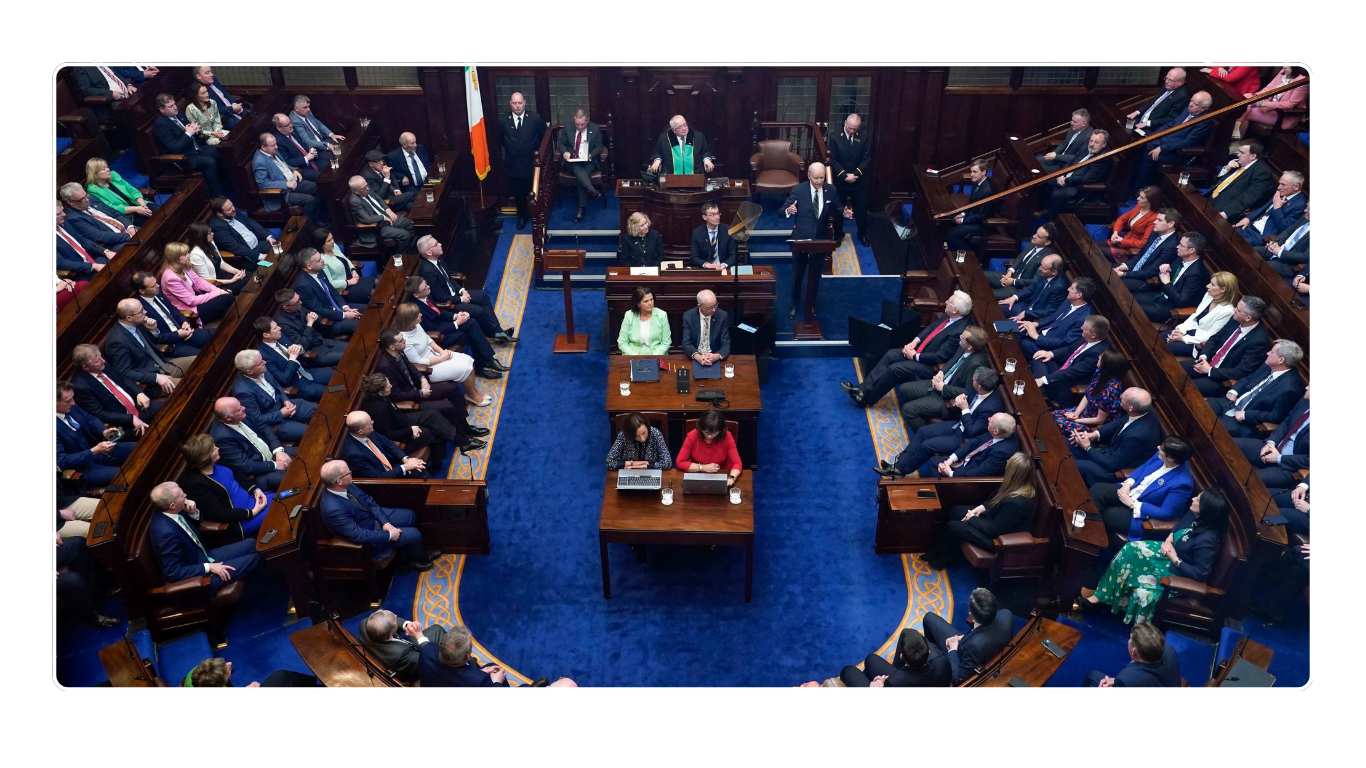
Irish TD’s in the Dáil
Irish political parties can be difficult to place on a simple left-to-right scale. Fianna Fáil and Fine Gael, the two parties that dominated government for much of the State’s history, developed from opposing sides of the Civil War rather than from a traditional divide between socialism and conservatism.
Modern Ireland has a much more fragmented political system. Fianna Fáil and Fine Gael remain the largest governing parties, Sinn Féin is the largest opposition party, and voters can also choose from Labour, the Social Democrats, the Green Party, People Before Profit–Solidarity, Aontú, Independent Ireland and independent candidates.
Information checked and updated: September 2026.
At a Glance
The current Dáil has 174 TDs, elected across 43 constituencies.
A working Dáil majority normally requires 88 votes.
Fianna Fáil won the most seats in the November 2024 general election, with 48 TDs.
Sinn Féin won 39 seats, while Fine Gael won 38.
The current Government was formed in January 2025 by Fianna Fáil and Fine Gael, with support and participation from independent TDs.
Ireland elects TDs using proportional representation by the single transferable vote, known as PR-STV.
Voters choose individual candidates in order of preference rather than placing one vote beside a party.
Irish parties do not always fit neatly into international definitions of left, centre and right.
The official 2024 general election results published by RTÉ provide the complete constituency and party breakdown. The Houses of the Oireachtas directory should be used to check current TDs and party affiliations.
Ireland’s Main Political Parties Compared
The descriptions below are broad guides rather than fixed definitions. Parties can adopt policies associated with different sides of the political spectrum, while individual TDs may place different emphasis on particular issues.
Fianna Fáil
Broad political position: Centre to centre-right
Seats won in 2024: 48
Current leader: Micheál Martin
Main priorities: Public services, home ownership, enterprise, regional development and Irish unity
Sinn Féin
Broad political position: Left-wing republican
Seats won in 2024: 39
Current leader: Mary Lou McDonald
Main priorities: Irish unity, State-led housing, public services, workers’ rights and cost-of-living measures
Fine Gael
Broad political position: Centre-right
Seats won in 2024: 38
Current leader: Simon Harris
Main priorities: Enterprise, economic management, tax reductions, public safety and European cooperation
Social Democrats
Broad political position: Centre-left
Seats won in 2024: 11
Current leader: Holly Cairns
Main priorities: Public housing, healthcare reform, equality, childcare and stronger public services
Labour Party
Broad political position: Centre-left
Seats won in 2024: 11
Current leader: Ivana Bacik
Main priorities: Workers’ rights, public services, housing, equality and social democracy
Independent Ireland
Broad political position: Right-of-centre and rural-focused
Seats won in 2024: Four
Current leader: Michael Collins
Main priorities: Rural Ireland, farming, fishing, local services, taxation and immigration controls
People Before Profit–Solidarity
Broad political position: Socialist left
Seats won in 2024: Three
Leadership: Collective structures
Main priorities: Public ownership, wealth taxes, housing, Irish neutrality, workers’ rights and climate justice
Aontú
Broad political position: Republican and socially conservative
Seats won in 2024: Two
Current leader: Peadar Tóibín
Main priorities: Irish unity, regional development, public services and opposition to abortion
Green Party
Broad political position: Green and centre-left
Seats won in 2024: One
Current leader: Roderic O’Gorman
Main priorities: Climate action, biodiversity, public transport, renewable energy and social equality
100% Redress
Broad political position: Regional and issue-based
Seats won in 2024: One
Main priority: Full redress for homeowners affected by defective concrete blocks
These are the seats won at the 29 November 2024 general election, not a permanent measure of party strength. Party representation can change when TDs resign, switch affiliation or are replaced in a bye-election.
In May 2026, Fine Gael’s Seán Kyne won the Galway West bye-election and Social Democrats candidate Daniel Ennis won in Dublin Central. The Electoral Commission confirmed that both assumed office on 26 May 2026.
Who Is Currently in Government in Ireland?
The Government formed on 23 January 2025 is led by Taoiseach and Fianna Fáil leader Micheál Martin. Fine Gael leader Simon Harris serves as Tánaiste.
Fianna Fáil and Fine Gael agreed the Programme for Government 2025, titled Securing Ireland’s Future, with the involvement and support of independent TDs.
The Government’s programme covers housing, infrastructure, taxation, healthcare, disability services, energy, climate policy, agriculture, childcare and the management of the public finances.
Government formation is about Dáil numbers as well as party size. No party won the 88 seats required for an outright majority in 2024:
Fianna Fáil: 48 seats
Fine Gael: 38 seats
Combined total: 86 seats
Normal majority threshold: 88 seats
Fianna Fáil and Fine Gael were therefore two seats short of a majority on their own and required support from outside the two parties.
This illustrates an important feature of Irish politics: winning the most seats does not automatically allow a party to govern alone. Parties and independent TDs must negotiate enough support for the Dáil to nominate a Taoiseach and sustain a government.
Fianna Fáil Explained
What does Fianna Fáil stand for?
Fianna Fáil is generally described as a centrist or centre-right republican party. It supports Irish unity, European Union membership, private enterprise, public investment and a significant role for the State in areas such as housing, healthcare and regional development.
The party was founded by Éamon de Valera in 1926 following a split in the republican movement over whether elected representatives should enter the Dáil.
Fianna Fáil grew into Ireland’s dominant party for much of the 20th century. Its support traditionally crossed social and economic categories, which is why it is frequently described as a “catch-all” party rather than a party representing one class or ideology.
Fianna Fáil’s main policy themes
Its recurring priorities include:
Increasing housing construction and home ownership.
Supporting businesses while funding public services.
Investment in roads, schools, hospitals and regional infrastructure.
Maintaining Ireland’s position within the European Union.
Supporting agriculture and rural communities.
Pursuing Irish unity through consent under the Good Friday Agreement.
Reducing taxes or increasing tax credits when public finances permit.
Fianna Fáil combines pro-business policies with support for State spending. Its precise position can therefore vary depending on the issue.
Who leads Fianna Fáil?
Micheál Martin has led Fianna Fáil since January 2011. He became Taoiseach for a second time in January 2025. His appointment and Cabinet nominations are recorded in the official Department of the Taoiseach announcement.
Fine Gael Explained
What does Fine Gael stand for?
Fine Gael is generally described as a centre-right party. It places a strong emphasis on enterprise, employment, economic competitiveness, tax reductions, law and order, European cooperation and responsible management of the public finances.
Fine Gael was established in 1933 through the merger of Cumann na nGaedheal, the National Centre Party and the Army Comrades Association.
Historically, Fine Gael developed from the pro-Treaty side of the Civil War divide. Fianna Fáil emerged from the anti-Treaty tradition, although the practical policy differences between the parties have changed substantially over the past century.
Fine Gael’s main policy themes
The party commonly prioritises:
Supporting businesses, entrepreneurs and foreign investment.
Reducing income taxes for workers.
Maintaining stable public finances.
Increasing home construction through State, private and approved housing body delivery.
Tougher criminal justice and public-safety measures.
Strong involvement in the European Union.
Investment in education, infrastructure and employment.
Protecting Ireland’s attractiveness as a place to invest and create jobs.
Fine Gael is a member of the centre-right European People’s Party in the European Parliament.
Who leads Fine Gael?
Simon Harris has led Fine Gael since March 2024. He served as Taoiseach from April 2024 until January 2025 and subsequently became Tánaiste.
Fine Gael’s current government commitments must be read alongside the joint Programme for Government because coalition agreements usually require parties to compromise on their individual manifestos.
Fianna Fáil Versus Fine Gael: The Main Differences
Historical origins
Fianna Fáil: Developed from the anti-Treaty republican tradition.
Fine Gael: Developed from the pro-Treaty tradition.
Broad modern position
Fianna Fáil: Generally positioned from the centre to centre-right.
Fine Gael: Generally positioned on the centre-right.
Economic approach
Fianna Fáil: Pro-enterprise, while supporting a pragmatic role for State intervention and public investment.
Fine Gael: Places greater emphasis on enterprise, competitiveness, tax reductions and careful management of the public finances.
Traditional image
Fianna Fáil: Traditionally viewed as a community-based, republican and broadly catch-all party.
Fine Gael: Traditionally associated with economic conservatism, European integration and law-and-order policies.
Irish unity
Fianna Fáil: Treats Irish unity as a core republican objective to be pursued peacefully and by consent.
Fine Gael: Supports unity by consent under the framework of the Good Friday Agreement.
European Union
Fianna Fáil: Strongly supports Ireland’s membership of the European Union.
Fine Gael: Strongly pro-European and affiliated with the centre-right European People’s Party.
Recent relationship
Fianna Fáil: Has governed in coalition with Fine Gael since 2020.
Fine Gael: Has governed in coalition with Fianna Fáil since 2020.
For generations, the Civil War divide helped explain why the two parties remained rivals despite considerable policy overlap.
That distinction has weakened. Their decision to enter coalition together in 2020—and to form another government in 2025—confirmed that they can now cooperate across most major areas of government.
The most meaningful differences are increasingly found in emphasis, political culture, candidates and individual policy proposals rather than in completely opposing economic systems.
Sinn Féin Explained
What does Sinn Féin stand for?
Sinn Féin is a left-wing republican party organised across the island of Ireland. It supports a united Ireland and seeks a referendum on constitutional change under the terms of the Good Friday Agreement.
Economically, Sinn Féin favours a larger State role in housing and public services. It generally supports increased spending on health, childcare and social protection, financed partly through higher taxes on wealth, very high incomes or selected business activities.
Sinn Féin’s main policy themes
These include:
A referendum and planning process for Irish unity.
Large-scale State construction of social and affordable housing.
Greater tenant protections and measures to reduce housing costs.
Increased spending on public healthcare.
Reducing childcare costs.
Stronger workers’ rights and collective bargaining.
Protecting Irish military neutrality.
Tax measures targeted at higher earners, wealth or particular sectors.
Cost-of-living supports for lower- and middle-income households.
The party’s latest detailed national platform remains its 2024 general election manifesto, although later budget documents and policy statements should be checked for updated positions.
Who leads Sinn Féin?
Mary Lou McDonald has led Sinn Féin since February 2018. Sinn Féin won 39 seats in the 2024 general election, making it the second-largest party in the Dáil and the largest opposition party.
Sinn Féin also operates in Northern Ireland, where it participates in the separate political institutions established under the Good Friday Agreement.
The Social Democrats Explained
What do the Social Democrats stand for?
The Social Democrats are a centre-left party founded in 2015. The party promotes a European-style social-democratic system in which higher-quality universal public services are funded through a broad and sustainable tax base.
It places particular emphasis on housing, healthcare, childcare, disability services, political reform and equality.
Main Social Democrats policies
The party’s recurring priorities include:
Building more public, affordable and cost-rental housing.
Implementing Sláintecare and reducing dependence on private healthcare.
Developing affordable public childcare.
Investing in disability and mental-health services.
Improving government accountability and political standards.
Progressive taxation to fund public services.
Climate action designed to protect lower-income households.
Expanding public transport and sustainable infrastructure.
The party increased from six seats in 2020 to 11 at the 2024 general election. Its victory in the Dublin Central bye-election in May 2026 subsequently brought its Dáil representation to 12.
Who leads the Social Democrats?
Holly Cairns, a TD for Cork South-West, has led the party since February 2023.
The Labour Party Explained
What does Labour stand for?
The Labour Party is Ireland’s oldest continuously operating political party, having been founded in 1912 by figures including James Connolly, James Larkin and William O’Brien.
It is a centre-left social-democratic party with historic links to the trade-union movement.
Labour’s main policy themes
Labour generally supports:
Stronger employment rights and trade-union recognition.
Increased public and affordable housing.
Universal public services.
Greater investment in health and education.
Progressive taxation.
Gender equality and LGBTQ+ rights.
Climate action and public transport investment.
A stronger social safety net.
European cooperation.
Labour has participated in several coalition governments, most commonly with Fine Gael. Its supporters argue that government participation allowed it to implement progressive policies, while critics have frequently blamed it for compromises made with larger coalition partners.
Who leads Labour?
Ivana Bacik has led the Labour Party since March 2022. Labour won 11 seats in the November 2024 general election.
The Green Party Explained
What does the Green Party stand for?
The Green Party combines environmental politics with broadly centre-left positions on social and economic issues.
Climate change is its defining concern, but its policies also cover housing, public transport, biodiversity, equality, energy and community development.
Green Party priorities
The party generally supports:
Faster reductions in greenhouse-gas emissions.
Major investment in buses, rail and cycling.
Renewable electricity and improved energy efficiency.
Retrofitting homes.
Protection and restoration of biodiversity.
Higher-density and transport-linked development.
Carbon pricing combined with assistance for affected households.
Socially progressive policies and international cooperation.
The Greens entered government with Fianna Fáil and Fine Gael in 2020. The party suffered major losses in the 2024 general election, falling from 12 TDs to one.
Who leads the Green Party?
Roderic O’Gorman, the party’s TD for Dublin West, has led the Green Party since July 2024.
People Before Profit–Solidarity Explained
What does People Before Profit–Solidarity stand for?
People Before Profit and Solidarity are socialist political organisations that contest elections under a shared banner. They are situated on the left of the Irish political spectrum.
They favour a considerably larger role for the State and public ownership than Ireland’s centre-left parties.
Main policy themes
They generally support:
Large-scale construction of public housing.
Rent controls and stronger tenant protections.
Higher taxes on wealth, large companies and high incomes.
Public ownership of essential services.
Free or heavily subsidised healthcare, education and childcare.
Stronger trade unions and employment protections.
Irish neutrality and opposition to military alliances.
Climate policies focused on major businesses and high emitters.
A united Ireland based on social and economic change.
The grouping has collective or party-specific leadership structures rather than one conventional national leader equivalent to those of Fianna Fáil or Sinn Féin.
Aontú Explained
What does Aontú stand for?
Aontú was founded by Peadar Tóibín in 2019 after he left Sinn Féin. Its name means “unity” or “consent”.
The party combines Irish republicanism, socially conservative positions and economically interventionist policies. It is best known for opposing abortion, but it also campaigns on housing, healthcare, regional inequality, Irish unity and government accountability.
Aontú’s main policy themes
These include:
Opposition to abortion and support for socially conservative policies.
Irish reunification.
Greater economic development outside Dublin.
Investment in public healthcare.
Housing construction and reductions in living costs.
Support for Irish businesses and farming.
Reform of government and public administration.
Tighter controls and planning around migration.
Aontú won two seats in the 2024 general election.
Who leads Aontú?
Peadar Tóibín, the TD for Meath West, has led Aontú since its establishment.
Independent Ireland Explained
What does Independent Ireland stand for?
Independent Ireland was founded in 2023. It seeks to provide a party structure for candidates with strong local and rural identities while allowing representatives a comparatively high degree of independence.
The party is commonly described as right-of-centre and rural-focused, although its representatives may differ on individual issues.
Independent Ireland’s main priorities
The party emphasises:
Agriculture, fishing and rural industries.
Maintaining local hospitals and public services.
Reducing taxes and regulation.
Support for small businesses and self-employed workers.
Greater regional investment.
Property rights.
Stricter management of immigration and international protection.
Greater local decision-making.
Independent Ireland won four seats in the 2024 general election.
Who leads Independent Ireland?
Cork South-West TD Michael Collins is the party’s leader and co-founder, according to his official Independent Ireland profile.
Independent Ireland is separate from independent TDs who do not belong to any political party.
100% Redress Explained
The 100% Redress party grew from the campaign for homeowners affected by defective concrete blocks, particularly in Donegal.
Its central demand is that affected homeowners should receive full State-funded redress for the cost of repairing or rebuilding unsafe properties.
Charles Ward won a Dáil seat for the party in Donegal in the 2024 general election. It remains primarily a regional and issue-focused organisation rather than a nationwide party offering a policy platform across every area of government.
What About Independent TDs?
Independent candidates play a much larger role in Ireland than in many other parliamentary democracies.
An independent TD is elected without belonging to a registered political party. Independents can still:
Vote for or against a Taoiseach.
Support or oppose a government.
Negotiate commitments for their constituencies.
Join technical groups to obtain speaking time.
Become ministers or Ministers of State.
Vote differently from one another on legislation.
Independents are not one ideological bloc. They range from left-wing and community-based representatives to rural conservatives and single-issue campaigners.
Voting for an independent can provide strong local representation, but an independent does not have the same national organisation, policy team or guaranteed group voting strength as a large party.
Why Ireland’s Political Spectrum Is Unusual
Most European political systems developed around a strong economic contest between left and right. Ireland’s party system initially developed around independence, the Anglo-Irish Treaty and the Civil War.
That created two large parties—Fianna Fáil and Fine Gael—with different historical identities but significant overlap on economic and social policy.
The system has changed considerably since the financial crisis:
Fianna Fáil and Fine Gael’s combined share of the vote has declined from earlier decades.
Sinn Féin has become a major electoral force.
The Social Democrats and other smaller parties have increased their representation.
Independent candidates continue to win significant local support.
Housing, healthcare, the cost of living, immigration and climate policy have become major dividing issues.
Coalition government has become the norm.
As a result, Irish voters frequently choose between parties based on a combination of ideology, leadership, local candidates, constituency work and coalition possibilities.
How Irish Elections Work
Ireland uses proportional representation by the single transferable vote, or PR-STV.
Each Dáil constituency elects three, four or five TDs. The Electoral Commission’s constituency guidance explains the current multi-seat structure.
Voters place candidates in order of preference:
Number 1 beside their first choice.
Number 2 beside their second choice.
Number 3 beside their third choice.
Further preferences if they wish.
A voter can rank candidates from the same party, different parties or a mixture of party and independent candidates. The Electoral Commission’s voting guidance confirms that voters may rank as many or as few candidates as they choose.
Candidates who reach the constituency quota are elected. Surplus votes and votes belonging to eliminated candidates can then transfer according to the next available preferences.
Worked Example: How the Election Quota Is Calculated
Assume a five-seat constituency has 60,000 valid votes.
The standard calculation is:
Quota = total valid votes ÷ (number of seats + 1), with the result rounded down, plus one
Therefore:
60,000 ÷ (5 + 1) = 10,000
10,000 + 1 = 10,001
A candidate who reaches 10,001 votes is elected.
Suppose your ballot reads:
Social Democrats candidate
Labour candidate
Sinn Féin candidate
Green Party candidate
Your vote initially goes to the Social Democrats candidate. If that candidate is eliminated—or is elected with votes available for transfer—your vote may move to the next candidate still in the contest.
This is why lower preferences can matter. Ranking a second candidate does not reduce the value of your first preference.
How to Compare Political Parties Properly
A party label is useful, but it should not be the only factor in deciding how to vote.
1. Compare policies on the issues that affect you
For example:
Housing supply and rent.
Income tax and USC.
Healthcare and waiting lists.
Childcare.
Transport.
Disability services.
Farming and rural development.
Climate and energy.
Immigration.
Irish unity and neutrality.
2. Look at how proposals would be funded
A promise to reduce taxes and increase spending at the same time should explain:
How much the policy will cost.
Which taxes or charges will change.
Whether borrowing will increase.
Whether another programme will receive less money.
Whether the proposal depends on volatile corporation-tax receipts.
3. Distinguish manifestos from government policy
A manifesto describes what a party wants before an election. A coalition programme describes what several parties have agreed to implement together.
Parties rarely deliver every manifesto promise, particularly when they enter government without a majority.
4. Assess the individual candidates
Under PR-STV, voters elect candidates rather than simply allocating seats to party lists.
Candidates from the same party may differ in experience, priorities, constituency work and personal position on conscience issues.
5. Consider likely coalition arrangements
A party may need to compromise to enter government. Voters should consider not only the party’s manifesto but also:
Which parties it could govern with.
Which policies it considers non-negotiable.
Whether it is prepared to remain in opposition.
How much influence its likely number of seats would provide.
Advantages and Limitations of Ireland’s Party System
Advantages
Voters have a wide choice of parties and independents.
PR-STV allows voters to rank candidates across party lines.
Smaller parties can win representation without receiving a huge national vote.
TDs remain closely connected to geographical constituencies.
Coalition negotiations can require compromise between different viewpoints.
Voters can distinguish between candidates from the same party.
Limitations
Coalition agreements can make it difficult to know which party is responsible for a policy.
Local constituency work can overshadow national policymaking.
The number of parties and independents can make government formation complicated.
Left-right labels do not always explain the real differences between Irish parties.
Election promises may be diluted during coalition negotiations.
Smaller parties can face a difficult choice between influencing policy in government and preserving their identity in opposition.
Frequently Asked Questions
Which political party is in power in Ireland?
Fianna Fáil and Fine Gael formed the Government in January 2025 with the involvement and support of independent TDs. Micheál Martin is Taoiseach and Simon Harris is Tánaiste as of September 2026.
What is the biggest political party in Ireland?
Fianna Fáil won the most seats in the 2024 general election, securing 48 of the 174 Dáil seats. Party size can be measured differently at Dáil, council, European and membership level, so the answer depends on the election being discussed.
What is the main opposition party?
Sinn Féin is the largest opposition party in the Dáil, having won 39 seats in November 2024.
Are Fianna Fáil and Fine Gael left-wing or right-wing?
Both are generally placed between the centre and centre-right. Fine Gael is more consistently classified as centre-right, while Fianna Fáil is often described as centrist, centre-right or a broad catch-all party.
Is Sinn Féin left-wing?
Yes. Sinn Féin is generally classified as a left-wing republican party. It supports greater State involvement in housing and public services alongside its central objective of Irish unity.
What is the difference between Labour and the Social Democrats?
Both are centre-left parties. Labour has historic links to the trade-union movement and has participated in several coalition governments. The Social Democrats were founded in 2015 and place particularly strong emphasis on Sláintecare, public housing, childcare and political reform.
Do I have to give every candidate a preference?
No. You may vote for one candidate or rank several candidates. However, additional preferences can allow your vote to remain active for longer if earlier choices are elected with a surplus or eliminated.
Is this guide about Northern Ireland as well?
The main comparison covers parties contesting elections in the Republic of Ireland. Northern Ireland has a separate party system, including Sinn Féin, the DUP, Alliance Party, Ulster Unionist Party and SDLP. Sinn Féin operates on both sides of the border.
Conclusion
Ireland’s political system cannot be understood through left-versus-right labels alone. Fianna Fáil and Fine Gael grew from the Civil War divide, Sinn Féin combines left-wing economics with Irish republicanism, and smaller parties offer choices ranging from social democracy and environmentalism to socialism, rural conservatism and socially conservative republicanism.
Before voting, compare each party’s current policies, funding assumptions, candidates and potential coalition partners. Most importantly, use the PR-STV system fully: your second and later preferences can help decide who represents your constituency without weakening your first choice.
Sources and Further Information
Houses of the Oireachtas: current TDs by party and constituency
Electoral Commission: Dáil constituency review and structure
Electoral Commission: registration of political parties and electoral functions
Department of the Taoiseach: appointment of the Government in January 2025
Methodology note
The political descriptions in this guide are based on official party policies, election manifestos, party affiliations in the European Parliament and the parties’ practical economic and social positions. Labels such as “centre-left” and “centre-right” are useful summaries, but they are interpretations rather than official legal classifications.
Party leaders, TD numbers, government arrangements and policies can change. Readers should check the Oireachtas directory, Electoral Commission and latest party publications before relying on those details.